| |||
| This Day in Gay History | |||
February 23 | |||

Noteworthy 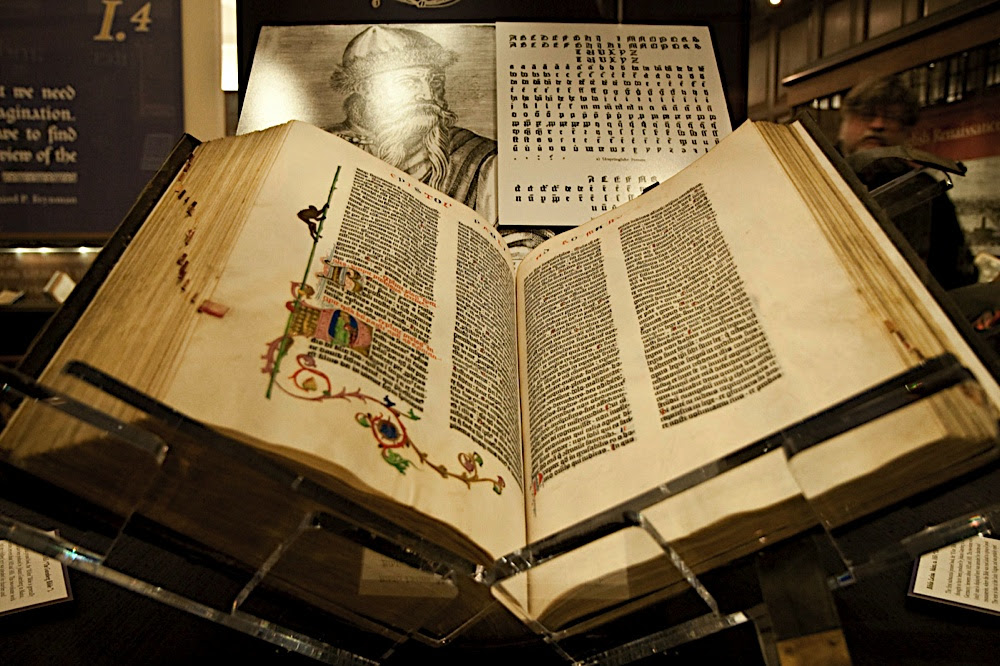 1455 - The traditional date for the publication of the GUTENBERG BIBLE, the first Western book printed from movable type thus transforming what had been an apocryphal transcription and imprecise oral tradition into rigid stone. While the Gutenberg Bible helped introduce printing to the West, the process was already well established in other parts of the world. Chinese artisans were pressing ink onto paper as early as the second century A.D., and by the 800s, they had produced full-length books using wooden block printing. Movable type also first surfaced in the Far East. Sometime around the mid-11th century, a Chinese alchemist named Pi Sheng developed a system of individual character types made from a mixture of baked clay and glue. Metal movable type was later used in Korea to create the “Jikji,” a collection of Zen Buddhist teachings. The Jikji was first published in 1377, some 75 years before Johannes Gutenberg began churning out his Bibles in Mainz, Germany. By studying the size of Gutenberg’s paper supply, historians have estimated that he produced around 180 copies of his Bible during the early 1450s. That may seem miniscule, but at the time there were probably only around 30,000 books in all of Europe. The splash that Gutenberg’s Bibles made is evident in a letter the future Pope Pius II wrote to Cardinal Carvajal in Rome. In it, he raves that the Bibles are “exceedingly clean and correct in their script, and without error, such as Your Excellency could read effortlessly without glasses.” Most Gutenberg Bibles contained 1,286 pages bound in two volumes, yet almost no two are exactly alike. Of the 180 copies, some 135 were printed on paper, while the rest were made using vellum, a parchment made from calfskin. Due to the volumes’ considerable heft, it has been estimated that some 170 calfskins were needed to produce just one Gutenberg Bible from vellum. Out of some 180 original printed copies of the Gutenberg Bible, 49 still exist in library, university and museum collections. Less than half are complete, and some only consist of a single volume or even a few scattered pages. Germany stakes the claim to the most Gutenberg Bibles with 14, while the United States has 10, three of which are owned by the Morgan Library and Museum in Manhattan. The last sale of a complete Gutenberg Bible took place in 1978, when a copy went for a cool $2.2 million. A lone volume later sold for $5.4 million in 1987, and experts now estimate a complete copy could fetch upwards of $35 million at auction. | ||
|8|O|8|O|8|O|8|O|8|O|8|O|8|O|8 Gay Wisdom for Daily Living from White Crane Institute "With the increasing commodification of gay news, views, and culture by powerful corporate interests, having a strong independent voice in our community is all the more important. White Crane is one of the last brave standouts in this bland new world... a triumph over the looming mediocrity of the mainstream Gay world." - Mark Thompson Exploring Gay Wisdom & Culture since 1989! |8|O|8|O|8|O|8|O|8|O|8|O|8|O|8 |