Monday, September 22, 2025

Via Dhamma Wheel | Right View: Understanding the Noble Truth of the Way to the Cessation of Suffering


TRICYCLE      COURSE CATALOG      SUPPORT      DONATE
RIGHT VIEW
Understanding the Noble Truth of the Way to the Cessation of Suffering
And what is the way leading to the cessation of suffering? It is just this noble eightfold path: that is, right view, right intention, right speech, right action, right living, right effort, right mindfulness, right concentration. (MN 9)

One practices mindfulness and full awareness . . . (DN 2)
Reflection
Having established that there is an escape from suffering, based on understanding what causes it in the first place, the teachings go on to lay out a path you can walk to get from here to there, from suffering to the end of suffering. It is an integrated path, involving many interrelated components, but at heart it requires the ability to be mindful and fully aware of all that happens in the realm of lived experience.
Daily Practice
Practice the skill of being mindful in all you do. That is, be aware of what is happening in the moment with an attitude of equanimity, neither attached to nor repelled by anything. Also practice the skill of doing all you do—in body, speech, and mind—with full awareness. That is, be carefully attentive to what you do as you do it. These two practices serve as the right and left steps along the path to the end of suffering.
Tomorrow: Cultivating Equanimity
One week from today: Understanding the Noble Truth of Suffering


Share your thoughts and join the conversation on social media
#DhammaWheel

Questions?
 Visit the Dhamma Wheel orientation page.
Tricycle is a nonprofit and relies on your support to keep its wheels turning.
© 2025 Tricycle Foundation
89 5th Ave, New York, NY 10003

Via FB


Via FB


Via FB


Via FB


Via FB


Sunday, September 21, 2025

Via Daily Dharma: The Whirlpool of Change


Browse our online courses »
The Whirlpool of Change

If we try to resist change and remain static, we will miss the truth every time. If we can just watch it closely, we will see that everything is part of this whirlpool of changing phenomena.

Ajaan Pannavaddho, “The Delusion of Memory”


CLICK HERE TO READ THE ARTICLE


Ritual and Devotion in Contemporary Tibetan Buddhism
A Premium Event with Anne C. Klein
Join Professor Anne C. Klein to explore ritual and devotion in Tibetan Buddhist practice today. Professor Klein will discuss ritual as an embodied practice, the centrality of devotion in Tibetan Buddhism, and navigating ritual as a cultural outsider. 
Sign up »

Via Dhamma Wheel | Right Mindfulness and Concentration: Establishing Mindfulness of Mind and Abiding in the Third Jhāna


TRICYCLE      COURSE CATALOG      SUPPORT      DONATE
RIGHT MINDFULNESS
Establishing Mindfulness of Mind
A person goes to the forest or to the root of a tree or to an empty place and sits down. Having crossed the legs, one sets the body erect. One establishes the presence of mindfulness. (MN 10) One is aware: “Ardent, fully aware, mindful, I am content.” (SN 47.10)
 
When the mind is not liberated, one is aware: “The mind is not liberated”. . . One is just aware, just mindful: “There is mind.” And one abides not clinging to anything in the world. (MN 10)
Reflection
Consciousness itself is open and empty of defining characteristics. Its function is to reflect like a mirror whatever object presents itself—to simply be aware of it. The mind is bound by the emotions, attitudes, and viewpoints it becomes entangled in, and these bonds change from moment to moment. In meditation one can sometimes distinguish between “just knowing” itself, and the mind’s many other more elaborate co-activities. 
Daily Practice
The mind is not liberated most of the time, meaning it is bound by various habits, influences, assumptions, projections, and other residue accumulated through past activity. Mindfulness of mind is the practice of just observing the mind, however it naturally manifests in experience. Practice simply noticing what is there, without commentary and without elaboration. Sometimes its bound, and sometimes its free.
RIGHT CONCENTRATION
Approaching and Abiding in the Third Phase of Absorption (3rd Jhāna)
With the fading away of joy, one abides in equanimity; mindful and fully aware, still feeling pleasure with the body, one enters upon and abides in the third phase of absorption, on account of which noble ones announce: “One has a pleasant abiding who has equanimity and is mindful.” (MN 4)     
Tomorrow: Understanding the Noble Truth of the Way to the Cessation of Suffering
One week from today: Establishing Mindfulness of Mental Objects and the Fourth Jhāna

Share your thoughts and join the conversation on social media
#DhammaWheel

Questions?
 Visit the Dhamma Wheel orientation page.
Tricycle is a nonprofit and relies on your support to keep its wheels turning.
© 2025 Tricycle Foundation
89 5th Ave, New York, NY 10003

Via Ram Dass - Love Serve Remember Foundation \\ Words of Wisdom - September 21, 2025 💠


"In your daily life, how do you become an instrument of social change? You become in yourself the statement of love, the statement of choiceless awareness, you become the moment so that your presence liberates everyone that comes near you if they are ready. You do nothing to anybody. You live your life.

Which life do you live? Whatever your dharma demands. If your work is to protest the injustice of races, you protest. If your work is to raise a family, you raise a family. If your work is to be a good lawyer, you're a good lawyer. If your work is to be a shoemaker, you're a shoemaker. If your work is to meditate in a cave, you meditate in a cave. No blame, no reward. You do your dharma."
 
- Ram Dass

Via White Crane Institute \\ oward A Gay Ecological Perspective: the Gay Experience and Ecology


White Crane InstituteExploring Gay Wisdom & Culture since 1989
 
This Day in Gay History

September 21


Today's Gay Wisdom
2017 -

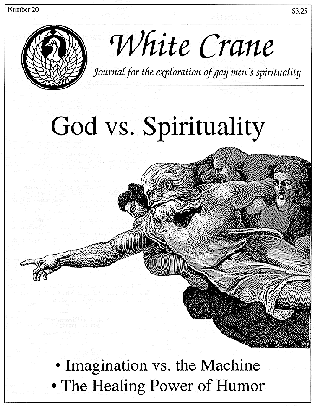
In 1992 White Crane #15 looked at The Wild Man, Robert Bly and Gays, and included a spirited debate among Harry Hay, Mark Thompson, and Arthur Evans on the origins of the Faeries. J. Michael Clark issued a call to ecological reflection:

Toward A Gay Ecological Perspective: the Gay Experience and Ecology

One important theme in Gay liberation is the realization that we cannot wait for others to sanction our efforts in theology or spirituality. We must instead find our own prophetic voice and assume our own authority to speak in theology and spirituality. Ultimately, neither Gay men and Lesbians, nor Native Americans, nor the poor, nor any other oppressed people can afford to wait for an external conferral of authority to speak. Moreover, the shared nature of oppression means that as we create our own liberation, so also are we obliged to seek the liberation of other people, and of the Earth itself, from objectification, disvaluation and exploitation.

Gay spirituality and theology, borne out of our experience of oppression, can contribute something unique to ecological reflection. While we would not expect the so called deep ecologists and other straight male writers to include our particular perspective, it is surprising that the majority of feminist writers also do not include Gay/Lesbian oppression as part of their analysis of human and ecological oppression and exploitation. Even when women, African Americans, Native Americans and Third World [sic] peoples and their environments are acknowledged and examined, Gay men and Lesbians are consistently absent and invisible. The extension of rights to Blacks, to women, and in a limited extent to some endangered species and the environment, conveniently passes over certain groups which, therefore, remain disenfranchised — most Native Americans, the poor, the homeless, and Gay men and Lesbians. These groups of people are all too much of the biosphere as well as invisible, even to so-called liberals, and treated as disvalued and disposable.

According to deep ecology, human self-centeredness has led to environmental problems. According to feminism, masculine privilege and social structures have devalued and exploited both women and nature. A Gay perspective would insist that not only are women, nature and the Earth devalued, but our society, with its fear of diversity, disvalues anyone (Gays, Lesbians, Native Americans, the poor and homeless, etc.) and anything (the environment, the Earth) designated as “other.” What we see is not just a devaluing which leads to domination and exploitation, but a disvaluing which strips away all value leading to exclusion, to being disposable, to being acceptable for extinction. This insight is one unique contribution to ecology which Gay people can offer, Gay thinking must move beyond the issues of domination and exploitation to those of disvaluation, exclusion and expendability to radically celebrate diversity and the intrinsic value of all that is, the human, the biospheric, the geospheric. Gay people must work against the disvaluation and exclusion of self and world as disposable, worthless commodities in a society that disdains diversity and eliminates the unnecessary — that which has no utilitarian value.

As Gay men and Lesbians look out on our disposable society of planned obsolescence and throw-away consumerism, we cannot help but be aware of the growing trash heap, the over-burdened landfills, the industrially polluted water and the wastelands of deforestation. We are able to see out society throwing away our Earth, our home, because we are also aware of how often human beings themselves have been treated as disposable and expendable. Historically, African-Americans, Native Americans, the poor and the homeless, the physically and mentally challenged and virtually all Third World [sic] peoples have been treated as either expendable after use (in slavery or minimum wage work) or as totally useless.

In the history of our own community, never has our expendability been so evident as in the rising incidence of anti-Gay violence and in the AIDS health crisis. Our government continues to spend money in the pursuit of protocols and vaccines, while ouor politico-medical system drags its feet in regard to approving treatment protocols or to finding a cure. Gay men, IV-drug users, people of color, and Third World [sic] communities where AIDS rages heterosexually are still devalued and/or disvalued. Our expendability becomes an example of our society’s attitudes toward all the Eart. Hence, our Gay ecological perspective must adamantly oppose any disvaluation and exclusion that leads to dispensing with diversity and disposing of life. Neither Gay men and Lesbians, nor the biosphere, nor the geosphere, nor any of the great diversity which god/dess creates and delights in is expendable.

An ecological perspective will also address our own lives as Gay men and Lesbians. We must be held accountable whenever we accede to or cooperate with the forces of oppression, exploitation and expendability. We must challenge any Gay/Lesbian assimilation which mitigates our diversity. Gor Gay men in particular, we must also examine our socialization as men. We must discern how we as men have been conditioned to accept exploitation, disvaluation and expendability — worthlessness — in our lives. If the typical masculine socialization process of our society works against a compassionate, caring, empathy for nature, spiritual Gay men who escaped that socialization may be able to demonstrate, for all men, a male-embodied love and care for nature.

As we (re)confront the abuses that imperil the environment, we can begin to create a Gay ecology that discloses that our Gay and Lesbian existence is not only a mode of being-in-the-world, but also a way of being-with-the-world, as co-partners in the process of healing and liberation throughout the Earth. Granted, in some respects Gay men and Lesbians, as a larger community, may lag behind other groups in wrestling with ecological issues and environmental causes because our energies are so consumed with dealing with AIDS, homophobia and other forms of oppression. Even with our considerable in-house agenda, which absolutely must not be forsaken, groups such as the various faerie circles and Gays United Against Nuclear Arms have pursued ecological concerns, while individuals have worked within local neighborhood groups on similar issues. Developing a broader, ecological perspective can help us see the connection among all forms of oppression, exploitation and disvaluataion and can facilitate liaisons to confront all of these. Not through co-option, but through cooperation, working together to achieve liberation for all peoples and the Earth itself, will we find out own liberation achieved as well.

Michael Clark is the author of Beyond the Ghetto: Gay Theology in Ecological Perspective, Pilgrim Press 1993


|8|O|8|O|8|O|8|O|8|O|8|O|8|O|8|

Gay Wisdom for Daily Living from White Crane Institute

"With the increasing commodification of gay news, views, and culture by powerful corporate interests, having a strong independent voice in our community is all the more important. White Crane is one of the last brave standouts in this bland new world... a triumph over the looming mediocrity of the mainstream Gay world." - Mark Thompson

Exploring Gay Wisdom & Culture since 1989!
www.whitecraneinstitute.org

|8|O|8|O|8|O|8|O|8|O|8|O|8|O|8|

Saturday, September 20, 2025

Via Daily Dharma: The Responsibility of Uncertainty


Browse our online courses »
The Responsibility of Uncertainty

Uncertainty is unnerving because it’s unpredictable but also because it demands a lot of us. If the future does not yet exist and we are creating the future in the present, then we have tremendous responsibility to actually engage.

Rebecca Solnit, “Taking Refuge in the Unknown”


CLICK HERE TO READ THE ARTICLE

Five Guidelines for Inner Safety
By Kim Allen
An Insight teacher provides practical tips for staying with different experiences while engaging in seated meditation.
Read more »