Saturday, October 11, 2025

Via White Crane Institute //


White Crane InstituteExploring Gay Wisdom & Culture since 1989
 
This Day in Gay History

October 11


1987 LGBT March on Washington
1987 -

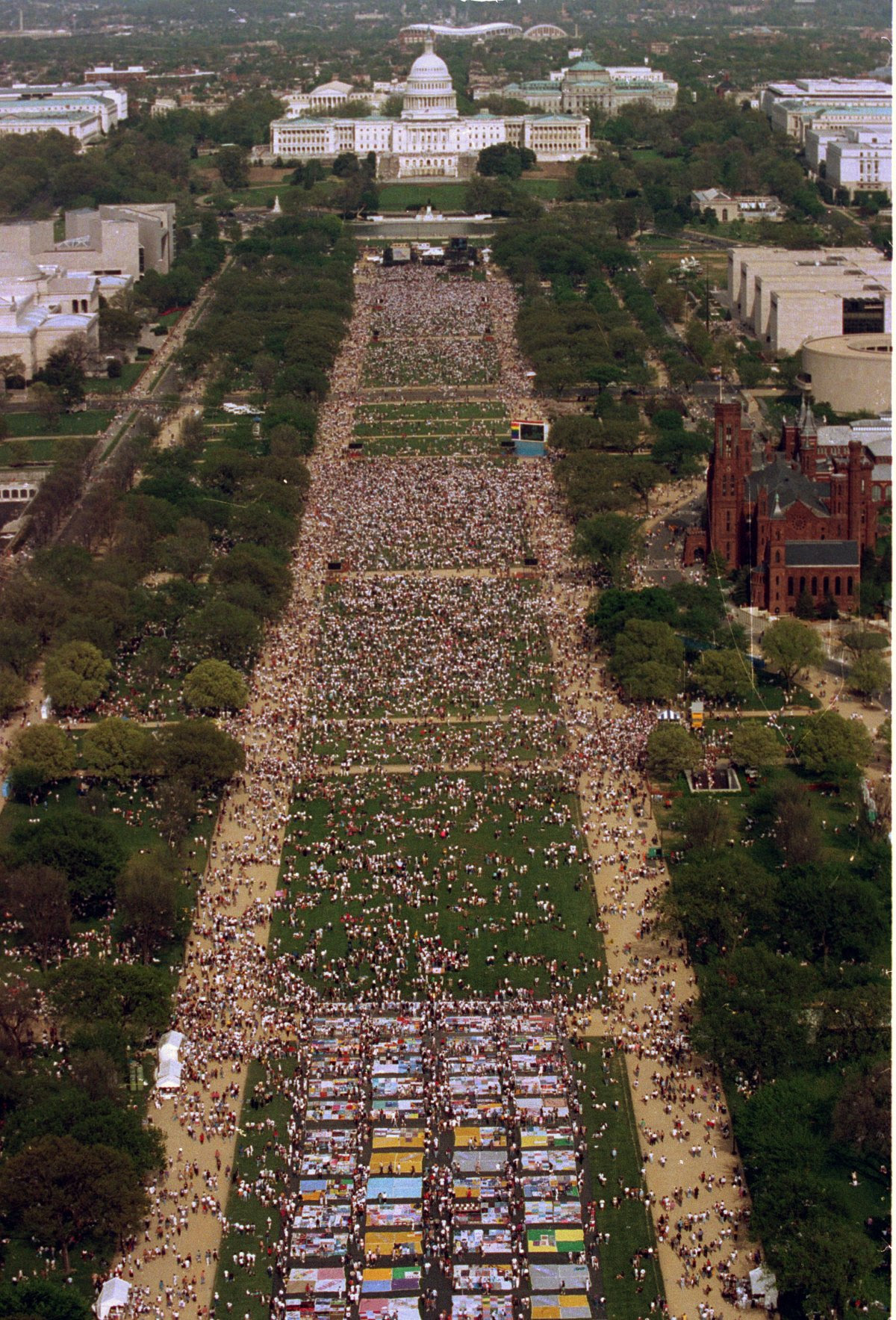
THE 2ND MARCH ON WASHINGTON FOR LESBIAN AND GAY RIGHTS. More than a half million people (between 300,000 and 1,000,000, according to organizers...considerably more than the number that attended the current occupant of the White House's inauguration) descended on the capital to participate in the second national March on Washington. Many of the marchers were angry over the government's slow and inadequate response to the AIDS crisis, as well as the Supreme Court's 1986 decision to uphold sodomy laws in Bowers v. Hardwick.

With the first display of the NAMES Project AIDS Memorial Quilt, the 1987 march succeeded in bringing national attention to the impact of AIDS on Gay communities. In the shadow of the U.S. Capitol, a tapestry of nearly two thousand fabric panels offered a powerful tribute to the lives of some of those who had been lost in the pandemic.

The march also called attention to anti-Gay discrimination, as approximately 800 people were arrested in front of the Supreme Court two days later in the largest civil disobedience action ever held in support of the rights of Lesbians, Gay men, bisexuals, and transgender people.

The 1987 March on Washington also sparked the creation of what became known as BiNet U.S.A. and the National Latina/o Lesbian, Gay, Bisexual, and Transgender Organization (LLEGÓ), the first national groups for bisexuals and GLBTQ Latinas and Latinos, respectively. Prior to the march, bisexual activists circulated a flyer entitled "Are You Ready for a National Bisexual Network?" that encouraged members of the community to be part of the first bisexual contingent in a national demonstration. Approximately 75 bisexuals from across the U. S. participated and began laying the groundwork for an organization that could speak to the needs of bi-identified people and counter the animus against bisexuals that was commonplace in both Lesbian and Gay communities and the dominant society.

By 1987, Latino GLBTQ activists from Los Angeles, Houston, Austin, and elsewhere had been meeting for two years, discussing ways to work together to further the basic rights and visibility of GLBTQ Latinas and Latinos. But with AIDS having a disproportionate impact on Latino GLBTQ communities throughout the United States, the activists recognized the need for a national organization and met at the March on Washington to form what was then called NLLGA, National Latina/o Lesbian and Gay Activists. Renaming themselves LLEGÓ the following year, the group has since expanded to address issues of concern to Lesbian, Gay, bisexual, and transgender Latinas and Latinos in other countries.

Along with the formation of new national groups, the most lasting effects of the weekend's events were felt on the local level. Energized and inspired by the march, many activists returned home and established social and political groups in their own communities, providing even greater visibility and strength to the struggle for Lesbian, Gay, bisexual, and transgender rights. The date of the march, October 11th, has been celebrated internationally ever since as National Coming Out Day to inspire members of the GLBTQ community to continue to show, as one of the common march slogans proclaimed, "we are everywhere."
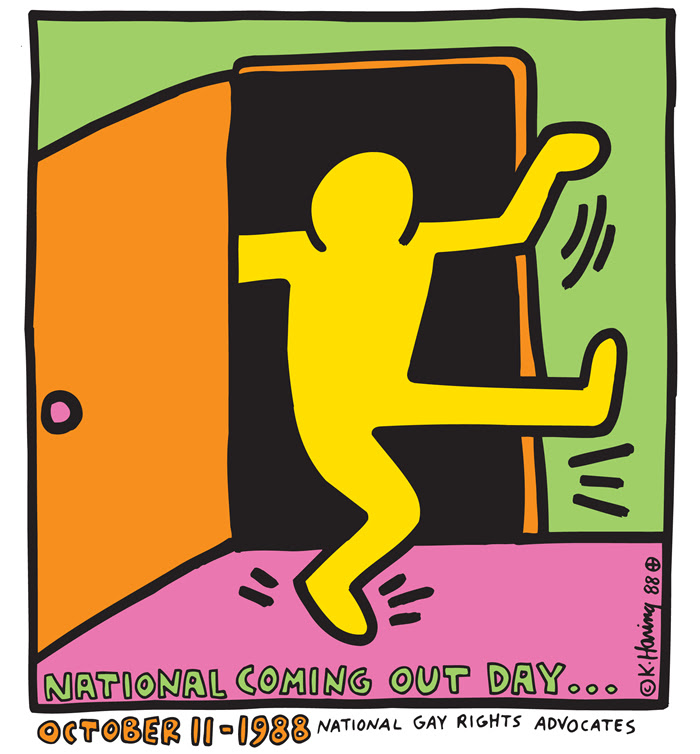

Original Keith Haring Poster for National Coming Out Day 1988
1988 -

NATIONAL COMING OUT DAY -- National Coming Out Day was founded by Robert Eichberg and Jean O'Leary on October 11, 1988 in celebration of the first Gay march on Washington D.C. a year earlier. The purpose of the march and of National Coming Out Day is to promote government and public awareness of Gay, bisexual, Lesbian and transgender rights and to celebrate homosexuality. National Coming Out Day is a time to publicly display Gay pride. Many choose this day to come out to their parents, friends, co-workers and themselves.


|8|O|8|O|8|O|8|O|8|O|8|O|8|O|8|

Gay Wisdom for Daily Living from White Crane Institute

"With the increasing commodification of gay news, views, and culture by powerful corporate interests, having a strong independent voice in our community is all the more important. White Crane is one of the last brave standouts in this bland new world... a triumph over the looming mediocrity of the mainstream Gay world." - Mark Thompson

Exploring Gay Wisdom & Culture since 1989!
www.whitecraneinstitute.org

|8|O|8|O|8|O|8|O|8|O|8|O|8|O|8|

Vis A Buddhist Take on AI Inbox The Tricycle Community


Browse our online courses »
October 11, 2025

How to Remain Embodied in a Disembodied World

With rapid advancements in artificial intelligence leading to an increasingly disembodied world, how do we remain true to ourselves and our practice? 

Rather than becoming beholden to AI, we can use Buddhist wisdom to inform the ways in which we engage with it—finding a middle way in our use of it and maintaining agency by choosing what to hand over and what to keep.

This Wednesday, October 15, at 1 p.m. ET, artificial intelligence scientist and Buddhist teacher Nikki Mirghafori will explore these topics and more during an hour-long conversation on Buddhism and AI. 

This event is free for Premium subscribers and $10 for general admission. Register today to join us!

 
Also this week:
  • Arthur Sze is officially the 25th US Poet Laureate! Enjoy this podcast episode with Sze to listen to some of his poetry.
     
  • Did you know that Tricycle hosts pilgrimages around the Buddhist world? Learn more about our trips to India, Nepal, and Thailand next year.
     
  • In this new Dharma Talk, Laura Bridgman explores how we can meet our experience—including the voice of our inner critic—with curiosity rather than judgment.
Blind Passions
By Mark Unno
Discover how to see clearly… that you’re a fool.
Read more »

Thursday, October 9, 2025

Via FB


Via FB


Via LGBTQ Nation //


Via The Tricycle Community \\ Three Teachings on Fear


Browse our online courses »
October 9, 2025

You Don’t Have to Think Your Way Out of Fear 
 
Although it may be more acute for some, fear is a universal emotion and everyday part of life. An instinct that protects us from harm, it’s not only natural but necessary for survival. 

But as meditation teachers Josh Korda and Kathy Cherry point out, fear is often based on a story from the past or anxiety about the future. When it’s within reason to observe that fear might be unfounded or at least not useful, its toll eases up.

The problem is that we can’t always talk or think our way out of fear. Whether observably valid, like an immediate threat to one’s physical safety, or the result of years, or lifetimes, of conditioned thinking, fear might be deeply rooted. What we can do is tap into embodied wisdom, like finding safety cues in the body and the physical world. We can also tap into compassion. 

Drawing from three traditions, this week’s Three Teachings offers three approaches to managing fear, each rooted in compassion for ourselves and each other.
Forward today's teachings to a friend »
Safety Resources for Discordant Times
By Josh Korda and Kathy Cherry 

Dharma Punx guiding teacher Josh Korda and founding member Kathy Cherry offer practices for letting the body lead when it comes to regulating fear.
Read more »
Trample on What Challenges You
By Anam Thubten

Tibetan Buddhist teacher Anam Thubten explains how the practice of chöd can help us break free from the shackles of fear while realizing compassion for all.
Read more »
Practicing Fearless Metta
By Kevin Griffin

Encouraging us to meet our fear with care and kindness, meditation teacher Kevin Griffin explains how the practice of metta can show us that love is the antidote to fear.
Read more »
Follow Us
                  
Unlock the wisdom of Buddhist teachings and deepen your practice with Tricycle’s online courses. 
 
Copyright © 2025 Tricycle Foundation
All rights reserved.
89 5th Ave | New York, NY 10003

Via FB


Via Daily Dharma: The Nature Within


Browse our online courses »
The Nature Within

Establishing a meditation practice where we become intimate with the elements offers us a way to connect to the presence of nature within ourselves, seeing over time that we are nature, not something separate from it.

Juliana Sloane, “A Practice for Connecting with the Four Elements That Can Be Done Anywhere”


CLICK HERE TO READ THE ARTICLE

The Thunderous Resonance of Bodhisattva True Great Sound
Kamilah Majied, PhD, with Dr. Peggy Rowe Ward
Buddhist teachers honor the life of Reverend Dr. Larry Ward.
Read more »

Via Dhamma Wheel | Right Action: Reflecting upon Verbal Action


TRICYCLE      COURSE CATALOG      SUPPORT      DONATE
RIGHT ACTION
Reflecting Upon Verbal Action
However the seed is planted, in that way the fruit is gathered. Good things come from doing good deeds; bad things come from doing bad deeds. (SN 11.10) What is the purpose of a mirror? For the purpose of reflection. So too verbal action is to be done with repeated reflection. (MN 61)

When you have done an action with speech, reflect on that same verbal action thus: “Was this action I have done with speech an unhealthy bodily action with painful consequences and painful results?” If, on reflection, you know that it was, then tell someone you trust about it and undertake a commitment not to do it again. If you know it was not, then be content and feel happy about it. (MN 61)
Reflection
Speech is such an important form of action, especially in our modern world of constant communication. It helps to think of speaking words as a form of planting seeds— something we want to do with care and with the hope of good fruits arising in the future. It is helpful to reflect on what seeds you have sown, and it is a blessing to be able to look back on what you have said to someone and feel content and happy about it.
Daily Practice
Reflect on what you have said to others from time to time, especially soon after saying it, and check in on whether your communication has been harmful or helpful. If you feel that something is “off” in some way, do not hesitate to share your concerns with a trusted friend and look for ways to repair the damage. Taking care of our healthy relationships is a form of right action, and attending to our speech is a way of doing this.
Tomorrow: Abstaining from Taking What is Not Given
One week from today: Reflecting upon Mental Action

Share your thoughts and join the conversation on social media
#DhammaWheel

Questions?
 Visit the Dhamma Wheel orientation page.
Tricycle is a nonprofit and relies on your support to keep its wheels turning.
© 2025 Tricycle Foundation
89 5th Ave, New York, NY 10003

Via FB


Via FB