HALLOWEEN -- The modern holiday of Halloween has its origins in the ancient Gaelic festival known as Samhain ("Sow-in" or alternatively "Sa-ven", meaning: End of the Summer). The Festival of Samhain is a celebration of the end of the harvest season in Gaelic culture, and is frequently regarded as 'The Celtic New Year'.
Traditionally, the festival was a time used by the ancient pagans to take stock of supplies and slaughter livestock for winter stores. Whether or not the ancient Celts considered Samhain to be the beginning of the new year, or just one point in the cycle of the seasons, the living traditions in the Celtic lands and the diaspora regard it as the "Celtic New Year" and it continues to be celebrated as such. For instance, the calendars produced by the Celtic League begin and end at Samhain/Halloween.
The Ancient Gaels believed that on October 31, the boundaries between the worlds of the living and the dead overlapped and the deceased would come back to life and cause havoc such as sickness or damaged crops. The festivals would frequently involve bonfires, where the bones of slaughtered livestock were thrown. Costumes and masks were also worn at the festivals in an attempt to mimic the evil spirits or placate them. When the Romans occupied Celtic territory, several Roman traditions were also incorporated into the festivals. Feralia, a day celebrated in late October by the Romans for the passing of the dead as well as a festival which celebrated the Roman Goddess Pomona, the goddess of fruit were incorporated into the celebrations. The symbol of Pomona was an apple, which is a proposed origin for the tradition of bobbing for apples on Halloween
The carved pumpkin, lit by a candle inside, is one of Halloween's most prominent symbols. This is an Irish tradition of carving a lantern which goes back centuries. These lanterns are usually carved from a turnip or "swede." The carving of pumpkins was first associated with Halloween in North America, where the pumpkin was available, and much larger and easier to carve. Many families that celebrate Halloween carve a pumpkin into a frightening or comical face and place it on their home's doorstep after dark.
The jack-o-lantern can be traced back to the Irish legend of Stingy Jack, a greedy, gambling, hard drinking old farmer who tricked the devil into climbing a tree, and trapped him by carving a cross into the trunk of the tree. In revenge, the devil placed a curse on Jack which dooms him to forever wander the earth at night. For centuries, the bedtime parable was told by Irish parents to their children. But in America the tradition of carving pumpkins is known to have preceded the Great Famine period of Irish immigration, and the tradition of carving vegetable lanterns may also have been brought over by the Scottish or English; documentation is unavailable to establish when or by whom. The carved pumpkin was associated generally with harvest time in America, and did not become specifically associated with Halloween until the mid to late 19th century.
This “in between time” has long been one which Gay people have taken on as their own holiday, reveling in masks and costumes. There are reasons Halloween is so closely associated with Gay people, some of which author and long-time White Crane contributor, Arthur Evans explained in his wonderful series of lectures in San Francisco in the mid-1970s which later became his book, Witchcraft and The Gay Counterculture. Here is a brief excerpt:
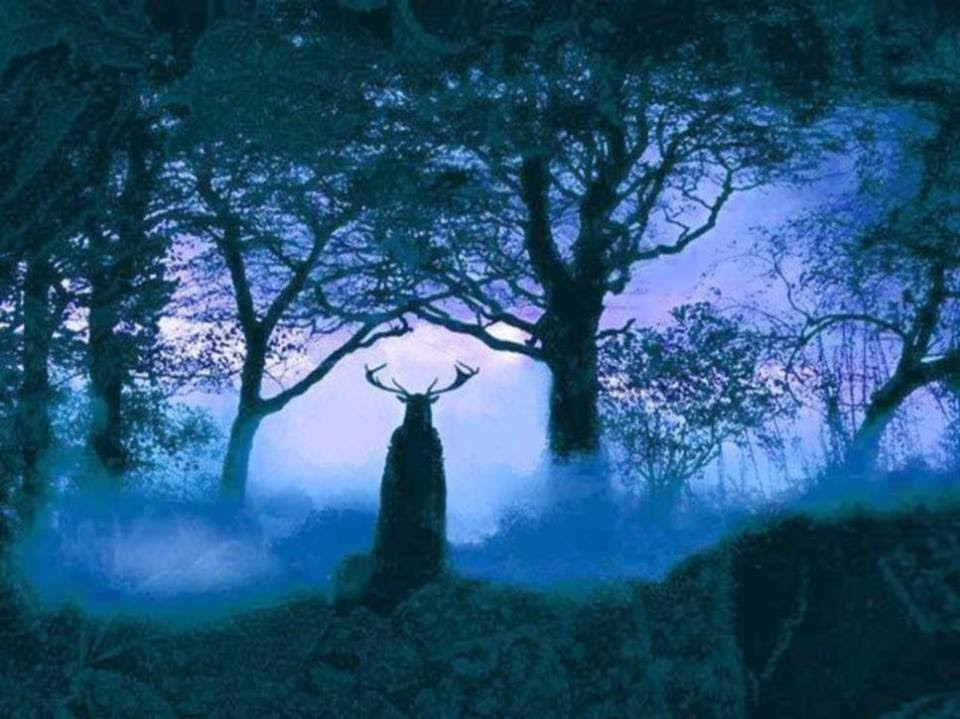
One Celtic male deity … is the horned god, “one of the most basic of the Celtic god types,” whose worship goes back to the Stone Age. He is often associated with the Mothers, as well as with sex, animals, and nature. He also seems to have links with male shamans. His great antiquity is shown by a Stone Age painting in Ariege, France, which shows a man dancing in the hide of an animal and wearing the antlers of a stag. And in the eighteenth century, construction workers inside Notre Dame Cathedral in Paris uncovered a four-sided Celtic stone altar dating from Roman times and bearing the figure of a bearded male deity with antlers. The stone was inscribed with the word Cernunnos, which means “The Horned One.”
The horned god was especially linked with male sexuality and often appears with an erect cock. Moreover, when erect, he is sometimes portrayed in the company of men, not women. A drawing of the horned god from Val Camonica, Italy, shows him holding a ceremonial collar ring in one hand and a horned serpent in the other. He is being worshiped by a man, and the man has an erection. This picture is reminiscent of early art scattered throughout Europe. The men often have erections and appear together in groups without women. In view of the Celts’ notoriety for homosexuality, these facts suggest a Gay element in the workshop of the horned god.
The horned god was also lord of the dead and the underworld. To the Celts, who believed in reincarnation, darkness and death were parts of the cycle of life and rebirth, and death was the very place where the creative forces of nature brought about new life. Because of this connection with the underworld the horned god was often shown as black in color. But this blackness was not considered evil, as Christianity later viewed it.
The depiction of the Celtic male god as an animal with horns is understandable in terms of the economy and religion of the times. Stone age Europe was dependent for its very existence upon the hunting of reindeer, red deer, and elk. Among the first animals to be domesticated were sheep and goats. Ancient Europeans, like all nature people, worshipped the animals they depended on, in contrast to modern, “civilized” people who objectify and destroy animals with all the impersonal violence that only scientific industrialism can devise.
The Celts dated the feast days of their religion according to the changing of the seasons, the breeding habits of animals, and the sowing and harvesting of crops. As in Judaism, feasts began on the night before the holiday. The four greatest Celtic holidays (with their Irish names) were Samhain (November 1); Imbolc (February 1); Beltaine (May 1) ; and Lugnasadh (August 1). These holidays were celebrated with ritual sexual promiscuity.
As it happens, these dates correspond exactly with the holidays later attributed by medieval Christians to witches. The Christians called these days, respectively, Halloween, Candlemas, Walpurgisnacht, and Lammas. Two other holidays were also celebrated by both Celts and witches: the winter solstice, December 21, surviving as the Feast of Fools; and the summer solstice, June 23, surviving as Midsummer Night. Shakespeare’s A Midsummer Night’s Dream, written in the late sixteenth century, has echoes of this holiday. The play is full of magic, faeries, human and animal sexuality. It features a leading character named Puck, or Robin Goodfellow – a descendent of the horned god.
Ritual transvestism associated with the old holidays continued in Europe down to modern times. “May Day sports perpetuated the practices, including even transvestism, and…in Wales, there existed, into the nineteenth century, a peasant dance and march with a garland, led by a dancer [a horned god figure] called the “Cadi.” In the twentieth century England such celebrations as the Helston Furry Dance, the Morris Dances, and the Peace Egg Mumming Play continued the tradition. In the Homanay celebration in Scotland, “the boys wore skirts and bonnets, the girls, hats and greatcoats.” The feast of Fools, a remnant of the old pagan religion, has persisted into modern times with clerics “wearing masks and monstrous visages at the hours of the office. They dance in the choir dressed as women, or disreputable men, or minstrels. They sing wanton songs.” Today many Gay people throughout Europe and America observe Halloween as a Gay holiday with transvestite celebrations. Originally, Halloween was one of the great holidays of the old religion – the Night of All Souls.
Excerpted from The Evans Symposium: Witchcraft & the Gay Counterculture and Moon Lady Rising, Arthur Evans,
© 2019 White Crane Books, ISBN: 078-1-7322844-0-1