A personal blog by a graying (mostly Anglo with light African-American roots) gay left leaning liberal progressive married college-educated Buddhist Baha'i BBC/NPR-listening Professor Emeritus now following the Dharma in Minas Gerais, Brasil.
If
the self is only conventionally and fundamentally empty at the core,
then the same goes for our social roles. The streams of identity change
over time; they deepen, dry out, or carve up a different path, but in
the ocean of emptiness, none of those distinctions exist.
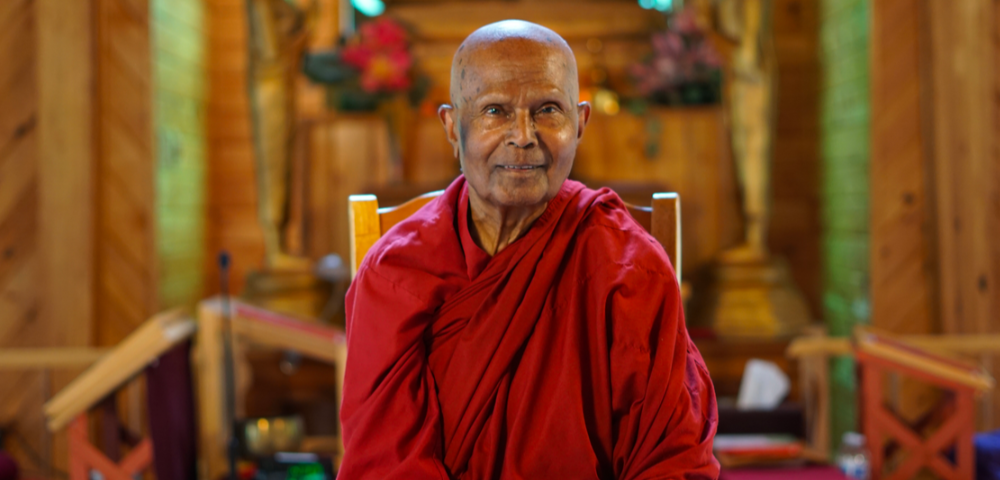
Clarifying Dependent Origination With Bhante Henepola Gunaratana
Watch
an illuminating teaching from Sri Lankan Theravada monk Bhante Henepola
Gunaratana on one of the Buddha’s most essential yet lesser-discussed
insights into the nature of suffering and liberation.
RIGHT VIEW Understanding the Noble Truth of the Cessation of Suffering
What is the cessation of
suffering? It is the remainderless fading away and ceasing, the giving
up, relinquishing, letting go, and rejecting of craving. (MN 9)
When one knows and sees bodily sensations as they actually are, then one
is not attached to bodily sensations. When one abides unattached, one
is not infatuated, and one’s craving is abandoned. One’s bodily and
mental troubles are abandoned, and one experiences bodily and mental
well being. (MN 149)
Reflection
Since craving
is the cause of suffering, the ending of craving will bring about the
end of suffering. This is both a general principle and a dynamic that
happens in every moment of lived experience. We are aware of something
different every moment, and when we either hold on to that object or
push it away, we feel discontent. Observing it with equanimity takes
away the affliction, and everything simply becomes interesting.
Daily Practice
Sensations flow
through your body in a constant stream. Some you like, some you don’t
like. It is natural to feel attached to the ones that feel good and to
resist and resent the ones that don’t, but this itself is the cause of
suffering—attachment and aversion. Practice just observing each
sensation without attachment, without infatuation, and see for yourself
how mindful equanimity results in bodily and mental well being.
Tomorrow: Cultivating Appreciative Joy One week from today: Understanding the Noble Truth of the Way to the Cessation of Suffering
Share your thoughts and join the conversation on social media #DhammaWheel
"When I start to get angry, I see my predicament and how I’m getting
caught in expectations and righteousness. Learning to give up anger has
been a continuous process. When Maharaji told me to love everyone and
tell the truth, he also said, 'Give up anger, and I’ll help you with
it.'
Maharaji offered me a bargain: 'You must polish the mirror free of anger
to see God. If you give up a little anger each day, I will help you.'
This seemed to be a deal that was more than fair. I readily accepted.
And he’s been true to his end of the bargain.
I found that his love helped to free me from my righteousness. Ultimately I would rather be free and in love than be right."
RIGHT MINDFULNESS Establishing Mindfulness of Feeling
A person goes to the forest
or to the root of a tree or to an empty place and sits down. Having
crossed the legs, one sets the body erect. One establishes the presence
of mindfulness. (MN 10) One is aware: “Ardent, fully aware, mindful, I
am content.” (SN 47.10)
When feeling a painful bodily feeling, one is aware: “Feeling a
painful bodily feeling" … one is just aware, just mindful “there is
feeling.” And one abides not clinging to anything in the world. (MN 10)
Reflection
Painful bodily
feeling is the most apparent aspect of our experience and is thus the
easiest sensation with which to practice. Pain is not an elusive feeling
tone. While it can be chronic and excruciating, most of the pain we
feel is mild and fleeting. Both pleasure and pain are inevitable aspects
of the human condition, and Buddhist practice does not encourage the
pursuit of pleasure or the avoidance of pain.
Daily Practice
As part of the
practice of mindfulness, you are invited to simply be aware of pain when
it is present. This practice has nothing to do with the natural
response of disliking the pain or wishing it were not there but involves
simply being aware of the sensation with equanimity. Turn toward the
painful sensation, take an interest in its texture, and hold it in mind
without pushing it away. Fully aware of the pain, you can still be
content.
RIGHT CONCENTRATION Approaching and Abiding in the Second Phase of Absorption (2nd Jhāna)
With the stilling of applied and
sustained thought, one enters upon and abides in the second phase of
absorption, which has inner clarity and singleness of mind, without
applied thought and sustained thought, with joy and the pleasure born of
concentration. (MN 4)
Reflection
The teachings around right concentration have to do with four phases of absorption, also known as jhānas.
When the mind rests steadily on a single object of attention—which is
quite difficult to do at first—it gradually disentangles itself from the
various hindrances and becomes unified, peaceful, and stable. With this
comes inner clarity and the dropping away of the internal use of
language.
Daily Practice
You will know when you have entered into absorption of the jhānas
because the state is accompanied at first with a great deal of physical
and mental pleasure. The physical pleasure is described as being
fundamentally different from any sensual gratification, and the mental
pleasure comes naturally when the mind is free of the hindrances (phase
one) and when it becomes concentrated or one-pointed (phase two).
Tomorrow: Understanding the Noble Truth of the Cessation of Suffering One week from today: Establishing Mindfulness of Mind and Abiding in the Third Jhāna
Share your thoughts and join the conversation on social media #DhammaWheel
We
rely on gifts from the universe to live (air, water, food). We live
together with all things. Why is it necessary to think we’re superior?
This is like our stomach thinking it’s more valuable than other parts of
our bodies.
Clarifying Dependent Origination With Bhante Henepola Gunaratana
Watch
an illuminating teaching from Sri Lankan Theravada monk Bhante Henepola
Gunaratana on one of the Buddha’s most essential yet lesser-discussed
insights into the nature of suffering and liberation.