
Thursday, June 25, 2026


Via James Fell \ FB

Jim Parsons is an openly gay man who played the character Sheldon Cooper on The Big Bang Theory. Sheldon had a web show within the show called Fun with Flags where he analyzed the history and symbolism of various flags, from Bavaria to Nebraska to Star Trek’s United Federation of Planets. But he did not cover the vexillology of the LGBTQ+ rainbow flag, so let’s have some fun.
--On This Day in History Shit Went Down: June 25, 1978--
A symbol of pride and social movements, the rainbow flag originated in San Francisco, making its first appearance at the city’s Gay Freedom Day Parade on June 25, 1978. It was designed by Gilbert Baker, a gay man and civil rights activist. He was tasked with making the flag by Harvey Milk, the first openly gay elected official in California.
Prior to 1978, the symbol for the LGBTQ+ movement was an inverted pink triangle, but this had significant negative connotations, what with it being designed by fucking Nazis to identify and persecute homosexuals. Although it had been reclaimed as a symbol of pride in the face of homophobia, Milk still wanted something uniquely their own.
One rumor proclaims Baker was inspired by Judy Garland singing “Over the Rainbow” in The Wizard of Oz, as Garland was one of the first gay icons. Another hypothesis states he borrowed from the World Peace Association’s multicolored Brotherhood flag.
Baker’s original design was eight-colored: hot pink, red, orange, yellow, green, turquoise, indigo, and violet. The colors represented, respectively: sex, life, healing, sunlight, nature, magic/art, serenity, spirit. Thirty volunteers hand-dyed and stitched two flags for the parade.
Five months later, Harvey Milk was assassinated; demand for the flag grew. Hot pink was dropped because of lack of availability of that fabric color. A year later, turquoise and indigo were merged into a single royal blue to make a six-stripe flag that remains most popular, although numerous other variations have sprung up over the years.
Thirty-seven years and one day later, the White House was illuminated in the colors of the rainbow flag to celebrate the federal legalization of gay marriage. And in June 2020, in a historic decision, the Supreme Court of the United States voted 6–3 asserting federal law prevents employers from discriminating against workers for being LGBTQ+.
History should take note that Justices Samuel Alito, Brett Kavanaugh, and Clarence Thomas voted on the side of bigotry.
NOTE: This piece was researched and written by a human, not some bullshit "ai" plagiarism software.
Those who cannot remember the past need a history teacher who says “fuck” a lot. Get both volumes of ON THIS DAY IN HISTORY SH!T WENT DOWN at JamesFell.com/books.
See less
Via Bil Browning’s Tummy Ache Nation \\\ These nuns want to make dying of cancer even worse
 |
Bil Browning’s Tummy Ache Nation is a reader-supported publication. You are currently a free subscriber. Upgrade to a paid subscription to help keep independent journalism alive.


 |
If you want to know why Americans are turning away from religion in droves, look no further than this shocking lawsuit. A group of Catholic nuns is suing for the right to disrespect dying transgender cancer patients.
What could possibly be so upsetting to the cadre of decidedly un-Christian sisters that forced them to file a lawsuit against the state of New York? They don’t want to refer to trans women as “she,” and they don’t want them dying in beds with other women nearby.
Now, Donald Trump’s Department of Justice has picked a side in the case, and, as you probably guessed, it’s siding with the nuns.
“For more than a century, the Dominican Sisters of Hawthorne have provided free palliative care to indigent cancer patients in their last days,” Assistant Attorney General Harmeet K. Dhillon of the Justice Department’s Civil Rights Division said in a statement. “New York’s law would force these religious women to choose between their faith and their license if they wish to continue serving the dying.”
Which is complete horseshit, of course. No one is asking the nuns to evangelize gender affirmation surgery. They’re simply required to treat dying people with respect. Apparently, that’s a step too far.
“It is unconstitutional for [the state] to dictate how the Sisters speak and how they care for those on their final journey,” one member of the nuns’ legal team declared without a hint of self-awareness of exactly how shitty that makes the sadistic sisters sound.
When someone is on their “final journey,” would Christ expect his followers to demean, antagonize, and insult them? Is that what the Catholic church is teaching its followers? I reached out to the Vatican to ask them, but didn’t get a response.
The federal government is spending taxpayer money to help nuns misgender cancer patients on their deathbeds. What does that say about this DOJ’s priorities? The civil rights division, which was created to protect minorities, not harass them, has made a determined effort to undermine absolutely everything the department has championed for decades under Dhillon’s leadership.
It’s not shocking that Trump is eagerly watching his toadies and henchmen work against minority groups, but Leo has supposedly made the protection and visibility of minorities and marginalized communities a cornerstone of his papacy.
For all of the positive PR the Church obviously seeks as it pits Pope Leo against Trump in a war of words, the sheer fact that he hasn’t picked up the phone and asked the naughty nuns, “What the fuck is wrong with you?” speaks volumes.
Share Bil Browning’s Tummy Ache Nation
Is it any wonder that only 65% of American Catholics think that religion has a positive view of religion? Only a quarter of them think that ignoring the law in favor of “but my religion tells me…” excuses is a net positive for the country.
In other words, 75% of American Catholics think petty bitches like the Dominican Sisters are doing the right thing, and almost half of them think that people like the nuns are making life worse for everyone.
And seriously, if using the word “she” to describe a woman who is dying is enough to get their knickers in a twist, these nuns have to be the worst possible choice to be caring for anyone about to shuffle off this mortal coil. They need compassion and respect, not abuse or callousness.
If disrespect and mean-spirited judgmental condemnation are all you have to offer, you’re in the wrong fucking business.
Christ fed the hungry, healed the sick, and sat with the dying. The Dominican Sisters sued the state of New York for the right not to. Somebody’s religion got lost on the way to the courthouse.
 |
|
Bil Browning’s Tummy Ache Nation is a reader-supported publication. You are currently a free subscriber. Upgrade to a paid subscription to help keep independent journalism alive.
Via White Crane Institute \\ Quote: LARRY KRAMER, was an American dramatist, author, activist, founder of ACT-UP
"We're all going to go crazy, living this epidemic every minute, while the rest of the world goes on out there, all around us, as if nothing is happening, going on with their own lives and not knowing what it's like, what we're going through. We're living through war, but where they're living it's peacetime, and we're all in the same country."
LARRY KRAMER, was an American dramatist, author, activist, founder of ACT-UP
Via White Crane Institute \\\ The RAINBOW FLAG
| |||
| This Day in Gay History | |||
June 25 | |||

Noteworthy 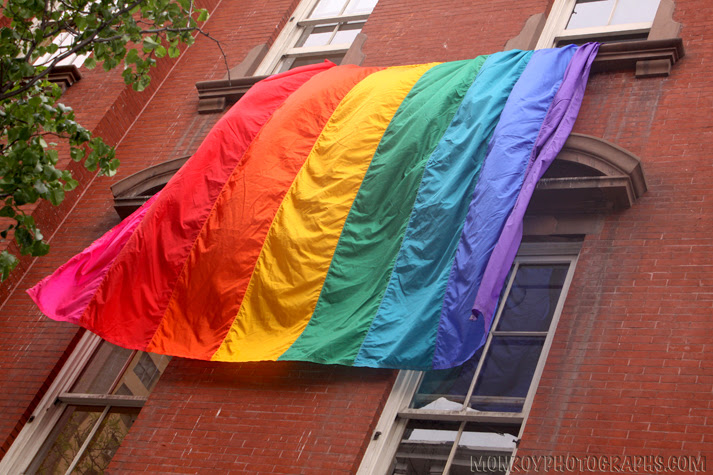 1978 - The RAINBOW FLAG is first displayed in the San Francisco Gay Pride Parade. While Gilbert Baker is widely recognized as the creator of the Rainbow Flag, the origins of the flag remain controversial. The late activist and author, Lee Mentley asserted -- we think correctly -- that it was made by artists from Eureka Noe Valley Artist’s Coalition, The Hula Palace, and Gay Freedom Day community volunteers in Top Floor Gallery. It was the summer of 1978, and the Gay Community Center in San Francisco swarmed with dozens of young people, flitting between ironing boards, swewing machines and trash cans filled with colorful dye. They had been tasked with making two enormous flags to fly above the city's Gay Freedom Day Parade, and they wanted something bright. Something inclusive. Something hopeful. Unbeknownst to them, their colorful project, the rainbow flag, would become the international symbol for LGBTQI rights, seen practically everywhere: atop City Hall in West Hollywood, in countries like Uganda, where homosexuality is still illegalm in the Target clothing aisle during Pride Month. The design and sewing of the first rainbow flag often is solely credited to the self-described "gay Betsey Ross," Gilber Baker -- a well-known activist and drag queen who died in 2017 -- with little or no mention of the artists and volunteers who helped that summer. Lynn Segerblom, who co-chaired the 1978 Gay Freedom Day decorations committee that year with Baker, remembers the conceptualization and creation of the rainbow flag as a joyous collaboration with friends. Segerblom and Paul Langlotz, who both witnessed the making of the giant banners, said Baker had been their friend and roommate but as soon as he started traveling the world promoting the flag, the stories of the other artists eventually fell by the wayside. In the interest of history, without Segerblom and a seamster, James McNamara, who died of HIV-AIDS in 1999, the flags wouldn't have happened. Mentley, in his recent book, The Princess of Castro Street [ISBN-10: 1533323844 - ISBN-13: 978-1533323842], disputes the origin story of the flag told by Gilbert Baker who claimed the flag design as his own. According to Mentley: “…Gilbert Baker who could barely finish any project he ever started was the 1978 co-chair of the Gay Day Decorating Committee would later … claim he created the rainbow flags all by himself, at Harvey’s [Milk] request nonetheless—but the artists knew he was no Betsy Ross! “Lynn Segerblon who was the other co-chair with Gilbert Baker of the Gay Day Decorating Committee, along with Hula Palace artist Robert Guttmann, presented their original idea to the Pride Board of the rainbow flag concept. “The Pride Foundation requested and found funding through the Hotel Tax. Lynn was the rainbow artist for Capezio downtown and professionally known as Faery Rainbow Argyle. It was Ms. Faery who, working with others, chose the colors and mixed the dye for one thousand yards of bleached muslin and designed the Rainbow and Rainbow American Flag, with a sole star placed within the stripes symbolizing “The State of Consciousness.” “More than one hundred artists worked on this amazing project.” The flag consisted of eight stripes: hot pink: sexuality; red: life; orange; healing; yellow: sunlight; green: nature; turquoise; magic/art; indigo: serenity/harmony; and violet: spirit. After the assassination of Harvey Milk, there was an increased demand for the flags. To meet that demand, the Paramount Flag Company began selling a version of the flag using stock rainbow fabric consisting of seven stripes of red, orange, yellow, green, turquoise, blue, and violet. In 1979 the flag was modified again. When hung vertically from the lamp posts of San Francisco's Market Street, the center stripe was obscured by the post itself. Changing the flag design to one with an even number of stripes was the easiest way to rectify this, so the turquoise stripe was dropped, which resulted in a six stripe version of the flag - red, orange, yellow, green, blue, and violet. Naturally, in the modifications, the two color elements that were lost: sex and magic/art. In the early years of the AIDS epidemic, AIDS activists designed a "Victory Over AIDS" flag consisting of the standard six-stripe rainbow flag with a black stripe across the bottom. Leonard Matlovich, himself dying of AIDS-related illness, suggested that upon a cure for AIDS being discovered, the black stripes be removed from the flags and burned. There is also an on-going controversey around the addition or changing of colors in the flag so individial communities within the LGBTQI communty can be represented. This misses the spirit of the flag. The stripes do not represent specific communities but ideals held by the community: Red represents life; orange is for healing; yellow is for sunlight; green is for nature; blue is for harmony; and purple is for spirit. The original flag had eight stripes, however there have been many iterations since. Today, the most commonly used flag, created in 1979, has six stripes. Still, there are other versions of the rainbow flag used to represent various queer subsets. At the 2018 Met Gala, for example, Lena Waithe wore a pride flag with black and brown stripes that were used to represent marginalized LGBTQIA+ people of color. It was introduced by the city of Philadelphia in 2017. In addition to the rainbow flag, there is also a transgender flag, a bisexual flag, and a gender fluid flag, to name a few. The rainbow flag remains a potent symbol of and for the LGBTQI Community. Daily GayWisdom pays tribute to the rainbow with the colors of every entry in GayWisdom. | ||
|8|O|8|O|8|O|8|O|8|O|8|O|8|O|8 Gay Wisdom for Daily Living from White Crane Institute "With the increasing commodification of gay news, views, and culture by powerful corporate interests, having a strong independent voice in our community is all the more important. White Crane is one of the last brave standouts in this bland new world... a triumph over the looming mediocrity of the mainstream Gay world." - Mark Thompson Exploring Gay Wisdom & Culture since 1989! |8|O|8|O|8|O|8|O|8|O|8|O|8|O|8 |
Via White Crane Institute \\ LARRY KRAMER
| |||
| This Day in Gay History | |||
June 25 1935 - LARRY KRAMER, was an American dramatist, author, activist, founder of ACT-UP born on this date (d: 2020). "We're all going to go crazy, living this epidemic every minute, while the rest of the world goes on out there, all around us, as if nothing is happening, going on with their own lives and not knowing what it's like, what we're going through. We're living through war, but where they're living it's peacetime, and we're all in the same country." Kramer was born Bridgeport, Connecticut and was educated at Yale University (class of 1957). He lived in London 1961-70, where he co-produced and co-wrote the film Here We Go Round the Mulberry Bush. Kramer next produced and wrote the screenplay for Women in Love, based on the novel by D. H. Lawrence, which was nominated for an Academy Award. Kramer had far less luck on his next film, a musical version of James Hilton's Lost Horizon released in 1973. It became one of the most notorious flops of the decade. Kramer was a Gay Rights advocate from the early 1970s, but never an orthodox one. His 1978 novel, Faggots, was one of the best-selling Gay-themed novels, but was heavily criticized by many Gay activists for its negative portrayal of Gay men’s sex lives and habits. Kramer was living in New York City when the AIDS epidemic began in 1981. He published a series of articles in the Gay newspaper the New York Native, including the famous "1,112 and Counting," urging action in response to the new epidemic. He was one of the founders of Gay Men's Health Crisis, a New York-based AIDS advocacy organization, which is still the world's largest provider of services to Gay men with AIDS. In 1987, increasingly discontented with the response to AIDS by both the U.S. government and the Gay male community, Kramer helped found the AIDS Coalition to Unleash Power (ACT-UP), an AIDS advocacy and protest organization often engaged in civil disobedience. Susan Sontag called him, "“One of America’s most valuable troublemakers." Kramer's 1985 play about the early years of AIDS, The Normal Heart, remains one of the most important cultural responses to the devastation of AIDS in the 1980s. It has had over 600 productions all over the world. Its New York production starred Brad Davis, who later died of AIDS. It is now used as a set text in many schools and universities. His next play, Just Say No (1988), was an attack on the Reagan administration and the Mayor of New York, Ed Koch, over what Kramer saw as their hypocrisy and inertia in responding to AIDS. It was less successful than The Normal Heart, possibly due to its sharply political tone. In 1989 Kramer published a book of non-fiction, Reports from the Holocaust: The Making of an AIDS Activist, a collection of his political writings from The York Times and other publications, which is an important record of the "heroic phase" of AIDS activism in the 1980s. During the 1990s, following his own diagnosis with HIV infection, Kramer became increasingly preoccupied with treatment issues, although he continued to issue regular polemical attacks on governments and health authorities. In 1998, he founded the Treatment Data Project, a coalition of private sector donors and medical institutes, designed to make AIDS treatment more readily available to people with HIV/AIDS. We Must Love One Another Or Die: The Life and Legacies of Larry Kramer, an anthology of essays edited by Lawrence D. Mass, is an important source on Kramer's career and the issues he worked on. In April 2001, Yale formally accepted a donation of Kramer's literary and political papers, along with a one million dollar donation from Kramer's brother Arthur Kramer to endow a Gay and Lesbian studies program. Kramer had been discussing the donation with Yale for several years, and the University had rejected a similar donation in 1997. Commenting on the results of their donation, in 2004, Kramer said: "My own college, Yale, with $1 million of my own brother’s money to do just this, will not teach what I call Gay history, unencumbered with the prissy incomprehensible gobbledygook of gender studies and queer theory." Kramer’s play The Normal Heart premiered on HBO as a film produced by Brad Pitt, Ryan Murphy ("Glee") and Scott Ferguson, and starring Mark Ruffalo. Matt Bomer, Jim Parsons, Alfred Molina, and Julia Roberts. Kramer died of pneumonia at home in New York City on May 27, 2020. |8|O|8|O|8|O|8|O|8|O|8|O|8|O|8 Gay Wisdom for Daily Living from White Crane Institute "With the increasing commodification of gay news, views, and culture by powerful corporate interests, having a strong independent voice in our community is all the more important. White Crane is one of the last brave standouts in this bland new world... a triumph over the looming mediocrity of the mainstream Gay world." - Mark Thompson Exploring Gay Wisdom & Culture since 1989! |8|O|8|O|8|O|8|O|8|O|8|O|8|O|8 | |||
Subscribe to:
Posts (Atom)