TODAY’S GAY WISDOM
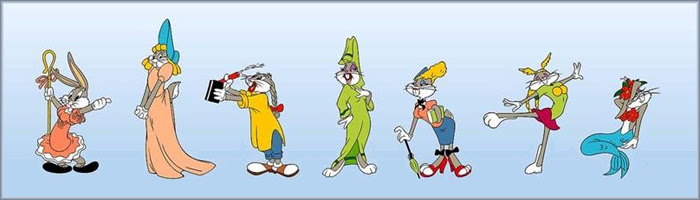
In the following list of cartoons, Bugs appears in some form of ladies garb or does a female-like turn:
Hare-um Scare-um (Hardaway/Dalton, 1939)
Bugs dresses up as a female dog to spoof the hunting dog.
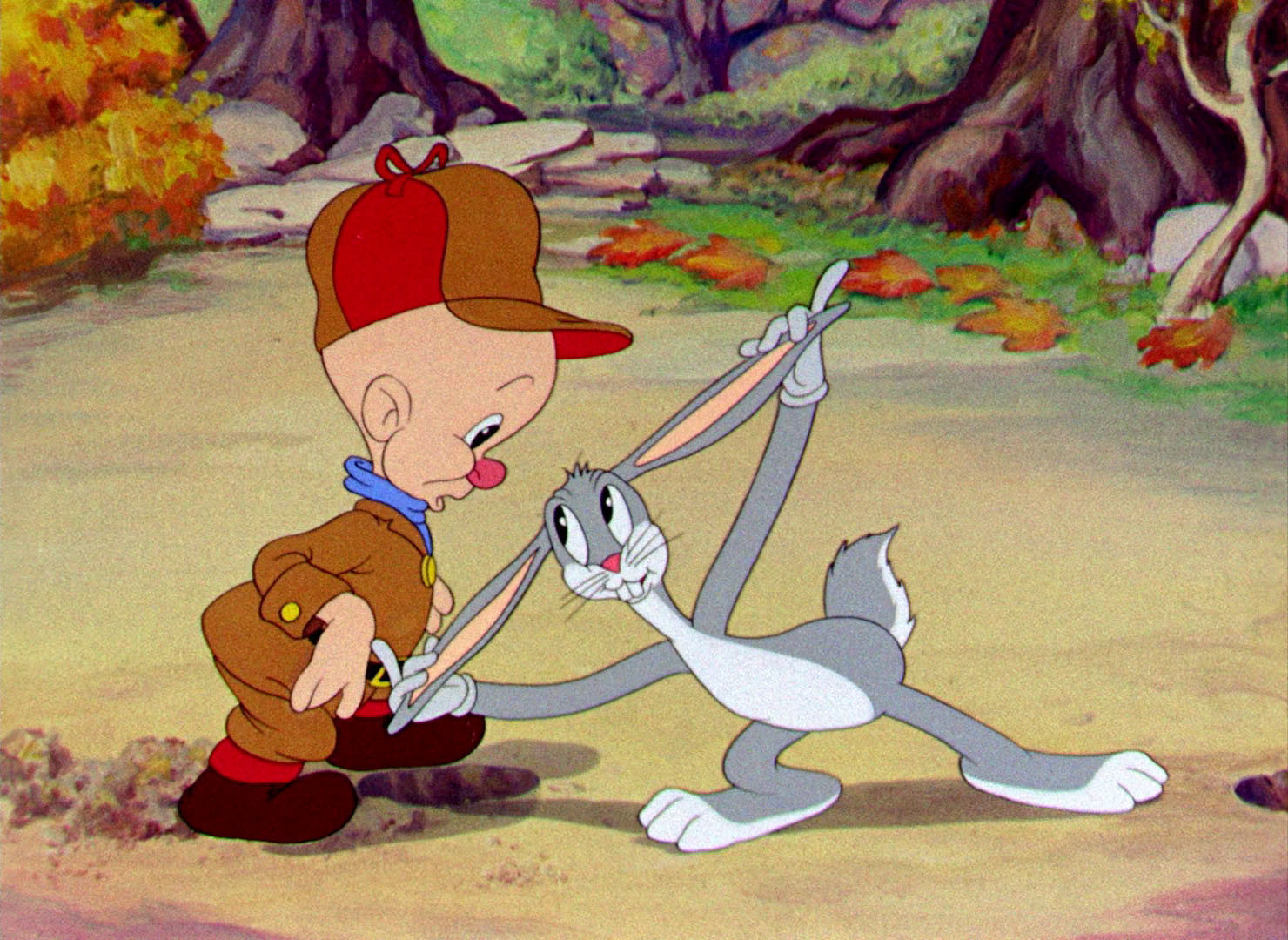
Elmer’s Pet Rabbit (Jones, 1941)
Bugs dances with Fudd and addresses him saying, Katherine Hepburn-like, “You dance divinely, really you do.”
The Heckling Hare (Avery, 1941)
The dog believing that he killed Bugs, lays flowers next to his home, and Bugs takes the dog’s flowers coquétteishly, saying “For me? Oh, you darling!”
The Wabbit Who Came to Supper (Freleng, 1942)
After shaving his face and underarms, and puff powdered, Bugs appears in womens’ lingerie and screams as Fudd opens the door on him.
Bugs Bunny Gets the Boid (Clampett, 1942)
Dances with Beaky Buzzard and asks “Why don’t we do this more often?” Also appears interrupted mid-shower by the bird, and replies coyly “You naughty, naughty boy!”
Super-Rabbit (Jones, 1943)
Brief appearance as Little Bo Peep owing to a costume mixup in a phone booth when changing into Super-Rabbit.
A Corny Concerto (Clampett, 1943)
Appears as a ballerina, ultimately wrapping his brassiere around the heads of Porky and his hunting dog.
What’s Cookin’ Doc? (Clampett, 1944)
Arises, Carmen Miranda-like, from a mountain of fruits and vegetables which have been hurled at him.
Bugs Bunny Nips the Nips (Freleng, 1944)
Appears as a geisha who mallets a Sumo wrestler.
Hare Ribbin’ (Clampett, 1944)
Appears as a blonde mermaid, driving the Mad Russian dog – well, mad.
Stage Door Cartoon (Freleng, 1945) One of the can-can dancers Fudd whistles at.
Herr Meets Hare (Freleng, 1945)
Appears as a Wagnerian heroine dancing with Hermann Göering. Same gag used again in What’s Opera, Doc? (Jones, 1957).
Hare Conditioned (Jones, 1945)
Appears as a lady customer who charms the Gildersleeve-like floorwalker, laughing hysterically when Gildersleeve tickles “her” mannequin’s foot.
Hare Trigger (Freleng, 1945)
In an old western setting, Yosemite Sam gets embarassed when opening a train door compartment only to find Bugs getting dressed.
Hair-Raising Hare (Jones, 1946)
Bugs distracts the pursuance by Gossamer (a hairy, orange, sneaker-wearing monster) acting as a beauty parlor stereotypical effeminate male manicurist. In a very feminine speech pattern, he states “I said to my girlfriend just the other day, …” Same gag except as a hairdresser used in Water, Water, Every Hare (Jones, 1952).
Easter Yeggs (McKimson, 1947)
Bugs ends up floating in a raft through a log upon which Elmer jumps in, only to come out the other end of the log (“Tunnel of Love”) with Elmer hugging Bugs and Bugs replying in a feminine voice, “I bet you say that to all the women.”
Mississippi Hare (Jones, 1948)
Appears as a dainty southern belle who is rescued by a big southern beau from the clutches of Colonel Shuffle. When the beau discovers Bugs is a rabbit, he goes into a trance and walks off the boat, prompting Bugs to observe that he almost had a happy ending.
Haredevil Hare (Jones, 1948)
Bugs as coquétte again, romancing K-9, observes that “there’s a beautiful Earth out tonight.”
Hare Splitter (Freleng, 1948)
Bugs impersonates his girlfriend Daisy Lou to abuse a rival, Casbah.
Bowery Bugs (Davis, 1949)
Bugs uses many disguises in this one, one of which is female, in order to heckle Steve Brodie, to the extent that Brodie jumps off the Brooklyn Bridge.
Long-Haired Hare (Jones, 1949)
Bugs appears as a bobby-soxer, asking for the autograph of Giovanni Jones with a dynamite pen.
Frigid Hare (Jones, 1949)
Bugs appears as an Eskimo woman to woo an Eskimo hunter away from catching a cute little penguin at the South Pole. The infatuated hunter gives Bugs a gift – a fish, which Bugs wears as a woman’s hat briefly before clobbering the hunter with it.
Rabbit of Seville (Jones, 1949)
Elmer chases Bugs into an opera house, where they wind up on stage performing The Barber of Seville. Bugs dresses up in a green dress, later dances with a wobbly Elmer, ending with Elmer dressed as a bride and Bugs the groom.
The Windblown Hare (McKimson, 1949)
Beginning with the wolf playing the role from The Three Little Pigs and changing to Little Red Riding Hood, Bugs appears as Little Red Riding Hood singing The Rabbit in Red to the tune of The Lady in Red.
What’s Up Doc? (McKimson, 1950)
Bugs tells of his career in flashback, from piano-playing as a baby to stardom at Warner Brothers, which includes a time when he appears as a ballerina.
Hillbilly Hare (McKimson, 1950)
Appears as an Ozark cutie who wows the Martin brothers.
Rabbit Fire (Jones, 1951)
Bugs appears as a huntress with Daffy as Gypsy, her hunting dog.
Water, Water, Every Hare (Jones, 1952)
Bugs portrays himself as a beauty parlor stereotypical effeminate male hairdresser to Gossamer, during which he strikes a pose in a very feminine manner. Same gag except as a manicurist used in Hair-Raising Hare (Jones, 1946).
Rabbit Seasoning (Jones, 1952)
Appears as a “stacked” Lana Turner-type, who bamboozles Fudd into shooting her a duck.
Southern Fried Rabbit (Freleng, 1952)
Bugs crosses the Mason-Dixon line towards Alabama where the carrot crop is healthy, only to encounter Yosemite Sam as a confederate soldier. Sam searches inside a southern plantation, while Bugs is dressed as a southern belle.
Hare Trimmed (Freleng, 1953)
First as Granny, then eloping with Yosemite Sam as a bride. Bugs’ bridal gown gets caught on a nail, revealing his tail. Upon seeing this, Sam goes nuts.
Robot Rabbit (Freleng, 1953)
Bugs once again dances with Fudd and addresses him saying, Katherine Hepburn-like, “You dance divinely, really you do.” Later, to distract a robot destroyer, Bugs appears as a robot cutie – in a potbellied stove, no less.
Rabbit Rampage (Jones, 1955)
Bugs, who has definite ideas as to how he should be drawn, clashes with and irritates the cartoonist who creates him, who proceeds to draw Bugs in all kinds of outrageous costumy appearance including two large hat scenes.
Napoleon Bunny-part (Freleng, 1956)
Bugs dresses as Josephine in a pink french gown and bonnet to fool Napoleon.
To Hare is Human (Jones, 1956)
Bugs dresses in a pink apron skirt with his ears tied in a bow during house cleaning chores, while Wile E. Coyote consults his Univac computer as to how to capture Bugs.
What’s Opera, Doc? (Jones, 1957)
In perhaps his most famous example of crossdressing, Bugs appears as Brünnhilde and sings the Maltese aria Return My Love, (set to Wagner’s Pilgrim Theme from Tannhäuser) with Elmer Fudd.
Bedevilled Rabbit (McKimson, 1957)
Bugs appears as a Tasmanian She-Devil to attract Taz.
Now, Hare This (McKimson, 1958)
Using the stories Little Red Riding Hood and Goldilocks and the Three Bears with three “male” characters (Bugs, Big Bad Wolf and his Nephew) could only result in all of them crossdressing. In the beginning skit the Nephew appears as Little Red Riding Hood and Bugs takes over that role while the Big Bad Wolf plays Grandma. The following skit has Bugs playing Goldilocks while the Big Bad Wolf doubles as Papa Bear and Mama Bear.
Hare-abian Nights (Harris, 1959)
Bugs finds himself having to entertain the Sultan as a story teller, and recalls a scene from Water, Water, Every Hare (Jones, 1952) where he portrays himself as a beauty parlor stereotypical effeminate male hairdresser.
Backwoods Bunny (McKimson, 1959)
While vacationing in the Ozarks, Bugs appears as a woman to distract a hillbilly buzzard from shooting him.
The Unmentionables (Freleng, 1963)
Appears as a flapper who kicks Rocky while doing the Charleston.
Bill of Hare (McKimson, 1962)
Bugs finds himself thrown in a cooking pot by Taz, only to pop out as a woman taking a bath.
Dr. Devil and Mr. Hare (McKimson, 1964)
Bugs teases Taz as a nurse.
Carrotblanca (Cahill/McNally, 1995)
In a theatrical short of the classic movie Casablanca with a Looney Tune twist, featuring beloved Bugs Bunny as the carrot-chomping proprietor (Bogart) of a wacky distortion of Casablanca’s Cafe Americain, Bugs appears as a blonde in a pink dress just before hitting Yosemite Sam with a pink purse containing an anvil.
From Hare To Eternity (Jones/Clough, 1996)
A musical/theatrical short with the Swashbuckler Yosemite Sam digging for treasure and finding Bugs, who distracts Sam by appearing as Buttercup, a mermaid.
Eh..tha—th-th-th-th-th-th-That’s All Folks!